
Why the World Grows a Mustache Every November
Movember began in Australia in 2003 as a small initiative, when a group of friends decided to grow mustaches to raise awareness for men’s health. Today, Movember, has grown into a global annual movement, also known as Men’s Health Awareness Month. Every November, millions of men grow mustaches not just for fun, but as a symbol and conversation starter. These visible signs of support help break the silence around health issues that are often overlooked or stigmatized, such as prostate and testicular cancers1. Men’s health awareness is crucial: men live on average 4.5 years less than women, and one in five dies before reaching age 652.
The movement has a clear mission: to shine a light on the health challenges men face and to fund vital research that improves prevention, diagnosis, and treatment for 3 main causes: cancer, testicular cancer and mental health issues.
Movember has transformed what might otherwise be a “taboo” topic into a global conversation. Since 2003, Movember has raised over €1.08 billion and funded more than 1,250 men’s health projects around the world, helping advance early detection, treatment, and mental health support. Prostate cancer remains the second leading cause of cancer death for men. Testicular cancer, though rare, mainly affects younger men and can often be cured if caught early3;4;5.
Myths vs. Facts: Men’s Health Edition
Despite Movember’s popularity, many misconceptions persist regarding men’s health issues. Let’s bust some common myths6;7;8;9;10.

Understanding Prostate and Testicular Cancers
Prostate and testicular cancers both begin when specific cells in the male reproductive system acquire genetic changes that disrupt their normal growth and death cycles, leading to uncontrolled division and tumor formation.
In the prostate, most cancers are adenocarcinomas that arise from the glandular cells lining the prostate, which normally produce fluid for semen; mutations in these cells make them grow abnormally, forming a mass that can remain confined to the gland for years or eventually invade surrounding tissues and spread through blood or lymph to bones and lymph nodes11.
Testicular cancer usually starts in the germ cells, the cells that develop into sperm, where early developmental or genetic disruptions cause precursor cells to lose normal maturation control and transform into testicular germ cell tumors (such as seminomas and non‑seminomas), which can grow within the testicle and, if untreated, spread to nearby lymph nodes and distant organs12.
Common signs to look for:
- Prostate cancer: Difficulty urinating, blood in urine, or pelvic discomfort (but often no symptoms early) 5;13.
- Testicular cancer: Swelling or painless lump in the testicle, a heavy feeling in the scrotum, or discomfort2.
The Impact of Prostate and Testicular Cancers
Prostate and testicular cancers both have a major impact on men, their families, and health systems, even though they affect different age groups and often have very different outlooks.
Prostate cancer is one of the most commonly diagnosed cancers in men and a leading cause of cancer‑related death, meaning large numbers of men live with the long‑term effects of treatment such as fatigue, sexual dysfunction, urinary problems, and emotional distress. In 2022, Prostate cancer was the most commonly diagnosed cancer in males in 118 of 185 countries14.
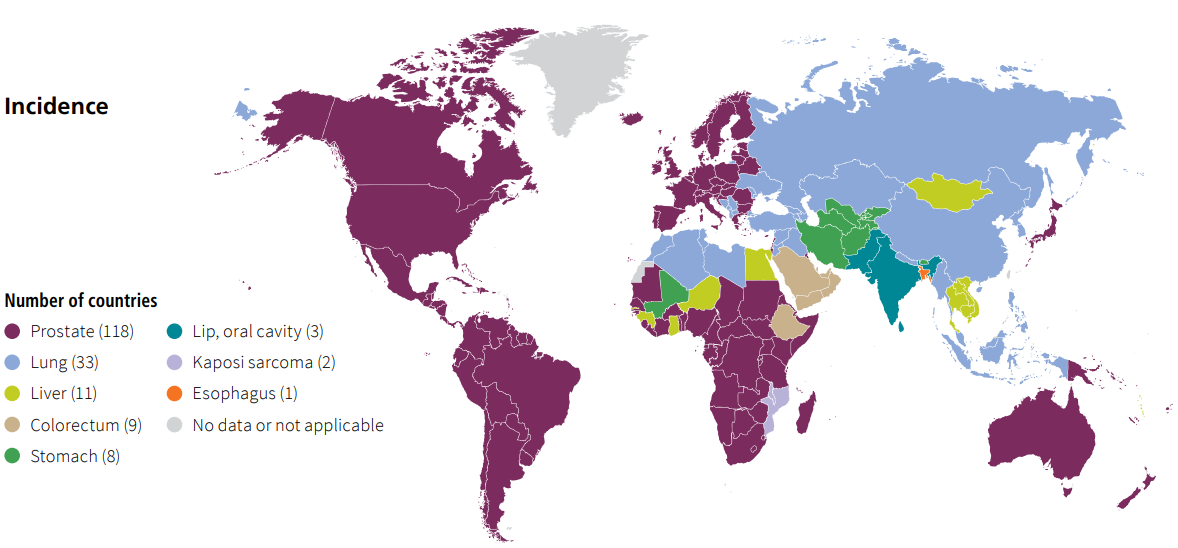
The most commonly diagnosed cancer among men in each country in 202214
Testicular cancer is much less common overall and is mostly diagnosed in younger men, often in their 20s or 30s, disrupting work, fertility plans, and mental wellbeing at a critical stage of life, even though cure rates are generally high, especially with modern treatments15.
Beyond the physical burden, both cancers can carry stigma and anxiety linked to masculinity, sexuality, and fertility that could be alleviated thanks to the global awareness campaigns carried out for Movember.
Support Resources Across Europe
Whether you’re seeking advice, screening, or emotional support, these European resources can help:
Pan-European Resources:
- Movember Foundation Europe: International support, project information, and personal stories (uk.movember.com, fr.movember.com, cz.movember.com…)
- Europa Uomo: European coalition of prostate cancer patient support groups
- European Cancer Organisation: Cancer screening information and policy updates (europeancancer.org)
Language-Specific Resources:
- English: Prostate Cancer UK, Cancer Research UK, NHS screening programs, MIND mental health support
- French: Institut Jules Bordet, Clinique Parc Impérial, GEREP prevention programs
- Dutch: Erasmus MC Cancer Institute
- German: Zentrum für Krebsregisterdaten (Center for Cancer Registry Data)
THERYQ’s mission
At THERYQ, we are committed to redefining how cancer is fought by pioneering innovative radiotherapy solutions. Our focus is on FLASH radiotherapy, an innovative technique that delivers radiation to cancer cells in a fraction of a second while sparing surrounding healthy tissue16.
By leveraging ultra-high dose-rate radiation, FLASH radiotherapy has the potential to shorten treatment sessions and reduce side effects, offering patients a safer and more tolerable alternative to conventional radiotherapy17.
This approach could represent a significant step forward in cancer care, bringing new hope to patients in need of more effective treatment options.
Note: FLASH radiotherapy is a novel technique, delivering radiation at ultra-high dose rates in a fraction of a second. This modality is currently being studied and is not clinically available.
Conclusion
Although prostate and testicular cancers are among the most common health issues affecting men, much remains to be understood about how these diseases develop and why some cases become more aggressive than others. Despite significant medical progress, early detection and timely consultation are still crucial for improving outcomes and ensuring men receive the care they need. Advances in diagnostics and treatments offer real hope, but ongoing research remains essential to further reduce mortality and improve quality of life.
Movember also highlights another equally important reality: men’s mental health. Too many men struggle in silence, whether facing illness or everyday pressures. Encouraging them to talk, seek help, and check in on one another is just as vital as promoting cancer screenings. By supporting awareness and fostering open conversations, we can help men take charge of their health both physically and mentally.
Sources:
1- Movember. (2020). About Us – Our story. Movember – About Us – Our story
2- Square Health. (2024). One of the largest networks of UK medical professionals. Square Health.
3- Movember. (2021). Mediaroom. Movember – Mediaroom.
4- Bournemouth University. (2025). Men’s health statistics amid Movember. Bournemouth University – Buzz. ] Men’s health statistics amid Movember
5- Harvard Health Publishing. (2016). Movember: Stashing prostate and testicular cancer awareness into the limelight. Harvard Health Publishing. Movember: Stashing prostate and testicular cancer awareness into the limelight – Harvard Health
6- Sutton Special Risk. (2024). Movember 2024 — Sutton Special Risk, Accident & Health Insurance MGU. Sutton Special Risk. Movember 2024 — Sutton Special Risk, Accident & Health Insurance MGU
7- Movember. (2021). Mediaroom. Movember Media Room – Mo Stats. Movember – Mediaroom
8- IARC/International Agency for Research on Cancer. (2014). Testicular cancer incidence to rise by 25% by 2025 in Europe? Model-based predictions in 40 countries using population-based registry data. IARC. Testicular cancer incidence to rise by 25% by 2025 in Europe? Model-based predictions in 40 countries using population-based registry data. – IARC
9- Movember. (2024). Changing the face of men’s health. Movember. Movember – Changing the face of men’s health – Movember
10- National Eating Disorders Association. (2024). Movember: Men’s Health and Eating Disorder Awareness. National Eating Disorders Association. Movember: Men’s Health and Eating Disorder Awareness – National Eating Disorders Association
11- Cleveland Clinic. (2025). Prostate Cancer: Symptoms, Causes & Treatment. Cleveland Clinic Health Library Prostate Cancer: Symptoms, Causes & Treatment
12- Gustave Roussy. (2025) Testicular cancer. Gustave Roussy Testicular Cancer: Pathogenesis, Diagnosis and Management with Focus on Endocrine Aspects – Endotext – NCBI Bookshelf
13- CERN Health Insurance Scheme. (2025). Movember – Prostate cancer awareness month – November 2025. CERN Health Insurance Scheme. Movember – Prostate cancer awareness month – November 2025 | CERN Health Insurance Scheme
14- American Cancer Society. (2024). Global cancer facts & figures (5th ed.). Global Cancer Facts & Figures-5th Edition
15- Rajpert‑De Meyts, E., Aksglaede, L., Bandak, M., Toppari, J., & Jørgensen, N. (2023). Testicular cancer: Pathogenesis, diagnosis and management with focus on endocrine aspects. In Feingold KR, Ahmed SF, Anawalt B, et al. (Eds.), Endotext [Internet]. MDText.com, Inc. (NBK 278992). Retrieved from https://www.ncbi.nlm.nih.gov/books/NBK278992/
16- Panaino, C. M. V., Piccinini, S., Andreassi, M. G., Bandini, G., Borghini, A., Borgia, M., Di Naro, A., Labate, L. U., Maggiulli, E., Portaluri, M. G. A., et al. (2025). Very high-energy electron therapy toward clinical implementation. Cancers, 17(2), 181. https://doi.org/10.3390/cancers17020181
17- Schüler, E., Acharya, M., Montay-Gruel, P., Loo, B. W., Vozenin, M., & Maxim, P. G. (2022). Ultra-high dose rate electron beams and the FLASH effect: From preclinical evidence to a new radiotherapy paradigm. Medical Physics, 49(3), 2082–2095. https://doi.org/10.1002/mp.15442